On average, the calories burned weight lifting for 30 minutes can be between 180 to 280 calories, depending on your weight. This is about 8 to 10 calories per minute.
Our calories burned weight lifting calculator not only helps you calculate the number of calories burned in a strength training session but can also calculate the calories burned for pushups, lunges, pull-ups, squats, Jumping Jacks, and ab exercises like sit-ups, crunches, and planks.
Use the calculator below to estimate your calories burned weight lifting and/or performing other body weight workouts.
When you purchase through links on our site, we may earn an affiliate commission. Here’s how it works.
Table Contents
Calories burned weight lifting calculator
To use the calories burned weight lifting calculator, follow these steps:
1. Enter your weight in pounds or kilograms
2. Enter the duration of your workout in minutes
3. Select all activities in your workout
The calculator will then calculate the calories burned weight lifting based on the average metabolic rate for your height and weight.
- The calculator assumes an even distribution of workout activities. If you select a workout with pushups, sit-ups, and weight lifting, it assumes an even division of your workout between each activity.
- The resistance / free weight workout is assumed to be multiple reps of weights between 60% to 80% of your 1 rep max.
Calories burned weight lifting can run into hundreds of calories per workout. If you’re using resistance weights, free weights, or your own body weight, lifting heavy things (combined with a healthy diet) is a solid proven path to weight loss and great muscle tone. For two free workout plans, head over to Free Workouts for Men Over 40.
How many calories burned weight lifting?
Depending on the intensity of your workout, the average person can burn between 350 to 550 calories lifting weights for an hour. However, there are several variables that can influence the calorie burn.
It is important to remember that weight lifting primarily builds muscle, and the actual calorie burn during the session might not be as high as other forms of cardio exercise. However, building muscle can increase your resting metabolic rate, leading to more calories burned throughout the day.
How many calories burned weight lifting 1 hour?
On average, you can burn between 360 to 560 calories in a 1-hour weight training session.
Use our quick table below to find the approximate calories burned weight lifting for 30 minutes and 1 hour or use our weight lifting calories calculator for a closer average.
Weight Ibs | 30 minutes | 1 hour |
120 | 171 | 343 |
130 | 186 | 371 |
140 | 200 | 400 |
150 | 214 | 429 |
160 | 229 | 457 |
170 | 243 | 486 |
180 | 257 | 514 |
190 | 271 | 543 |
200 | 286 | 572 |
210 | 300 | 600 |
220 | 314 | 629 |
What burns more calories... one hour of cardio or one hour of weight lifting?
The calories burned running are generally more than the calories burned weight lifting. However, it can be challenging to compare the two because they are different types of exercise and are both beneficial to your health. Running is cardio whereas weight lifting is resistance training.
Calories burned weight lifting versus calories burned running
The table below shows the estimates for calories burned weight lifting versus 1 hour of running.
| Weight Ibs | 1-hour weight lifting | 1 hour running (10min per mile) |
| 120 | 343 | 560 |
| 130 | 371 | 607 |
| 140 | 400 | 653 |
| 150 | 429 | 700 |
| 160 | 457 | 747 |
| 170 | 486 | 793 |
| 180 | 514 | 840 |
| 190 | 543 | 887 |
| 200 | 572 | 933 |
| 210 | 600 | 980 |
| 220 | 629 | 1027 |
Do you continue to burn calories after lifting weights?
Yes, while running may burn more calories in 1 hour, lifting weights tends to continue to burn calories after your training session. It’s estimated that this is about 6 to 15% extra calories.For example, if you burn about 300 calories during your workout, you can burn an additional 18 to 45 calories post-workout.
This phenomenon is thanks to EPOC (Excess Post-Exercise Oxygen Consumption): after intense activities, the body uses extra oxygen to replenish energy stores, repair muscle tissue, and restore the body back to its pre-workout state.
The number of calories burned through EPOC depends on the following factors:
- The workout duration
- Your workout intensity
- Your level of fitness
- How much muscle you have
- Your body weight
You can maximize the EPOC by doing HIIT workouts (high-intensity interval training), using compound movements such as squats and deadlifts, lifting heavier and reducing your rest breaks.
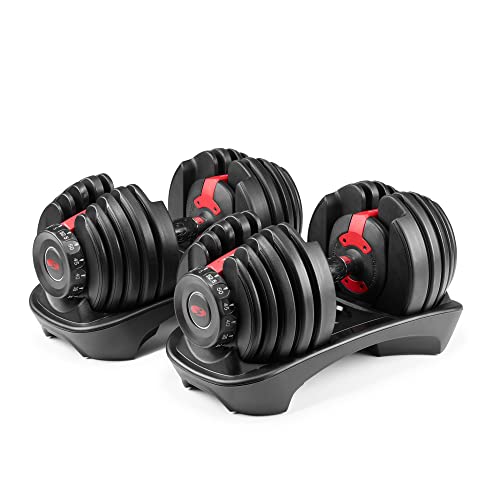
Adjustable dumbbell set from 2.5Ibs to 52.5Ibs.
- Each dumbbell adjusts from 2.5Ib to 52.5Ib with a turn of the dial
- No need to have multiple dumbbell sets
- Easy to adjust the weights
- Space efficient and neat
The set comes with a 2-month free trial to JRNY so that you can try out the motion tracking and strength training programs.